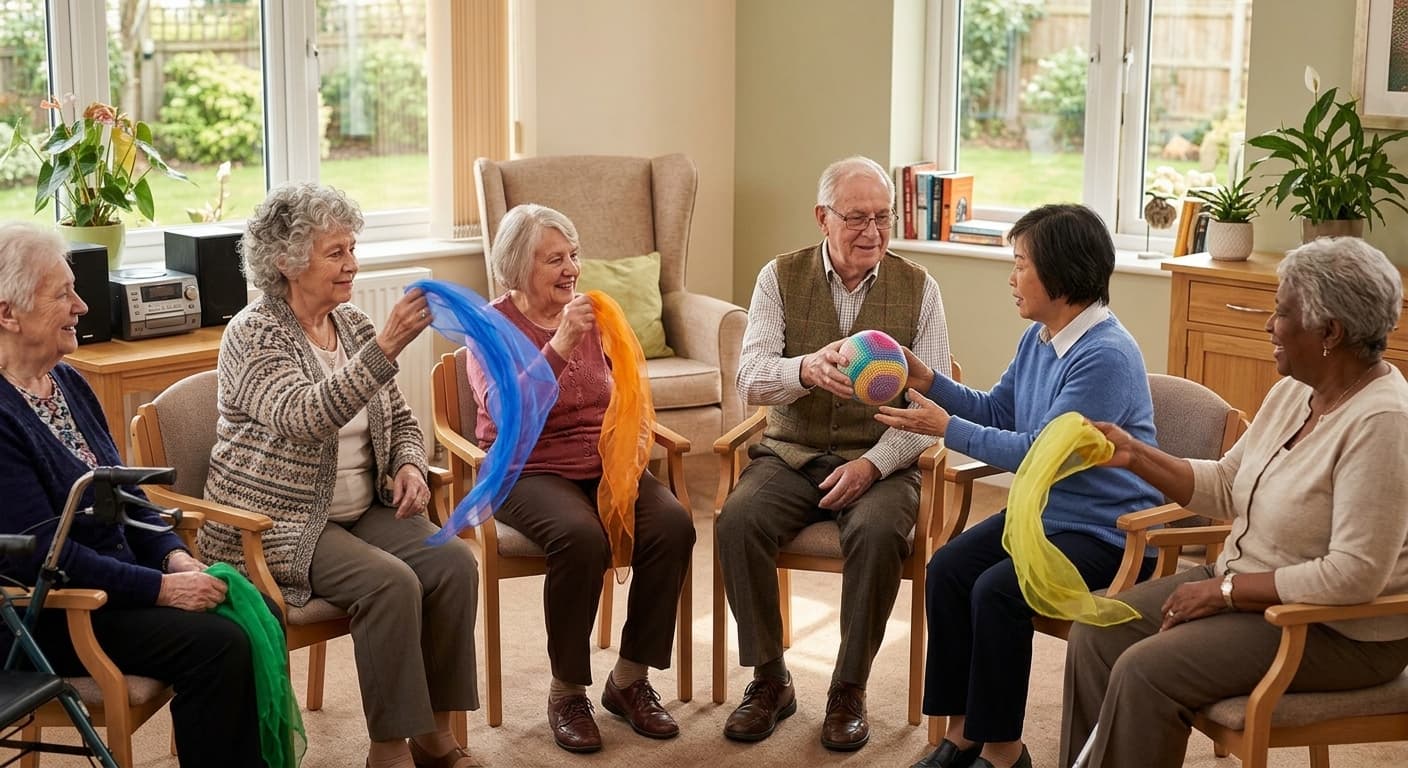
I recently called one of my new community projects Never Too Old to Play because I kept coming back to the same thought.
We give children permission to play.
They can dance because a song comes on. Throw a ball because it is fun. Make something with their hands. Play a board game. Dig in the garden. Sing. Build. Explore. Laugh while they move.
Then somewhere through adulthood we start giving these things more serious names.
Exercise. Recreation. Hobbies. Therapy. Activities.
Sometimes play is still the best word for it.
We do not stop benefiting from enjoyable movement simply because we become adults.
Screens are not the whole problem
I have been thinking about screens a lot because I see the same conversation appearing at both ends of the lifespan.
I do not think a phone, tablet or television automatically makes somebody unhealthy.
My concern is what can quietly disappear around them.
A song that once had us moving becomes something we listen to while sitting.
A game becomes an app.
Conversation can become two people scrolling beside one another.
Small physical jobs can become things somebody else routinely does for us.
The issue I keep coming back to is opportunity.
Bodies need reasons to move, and people need reasons to participate.
This is something I see at both ends of the lifespan
In my work with children through Play Move Improve, I spend a lot of time encouraging adults to protect opportunities for children to jump, climb, run, balance and play.
I wrote more about that in Why I still want children to jump.
My older adult work makes me think about the same issue from the other direction.
Are we still creating enough reasons for people to stand, reach, walk, carry, move, laugh, explore and join in?
Movement does not always need to begin with an exercise.
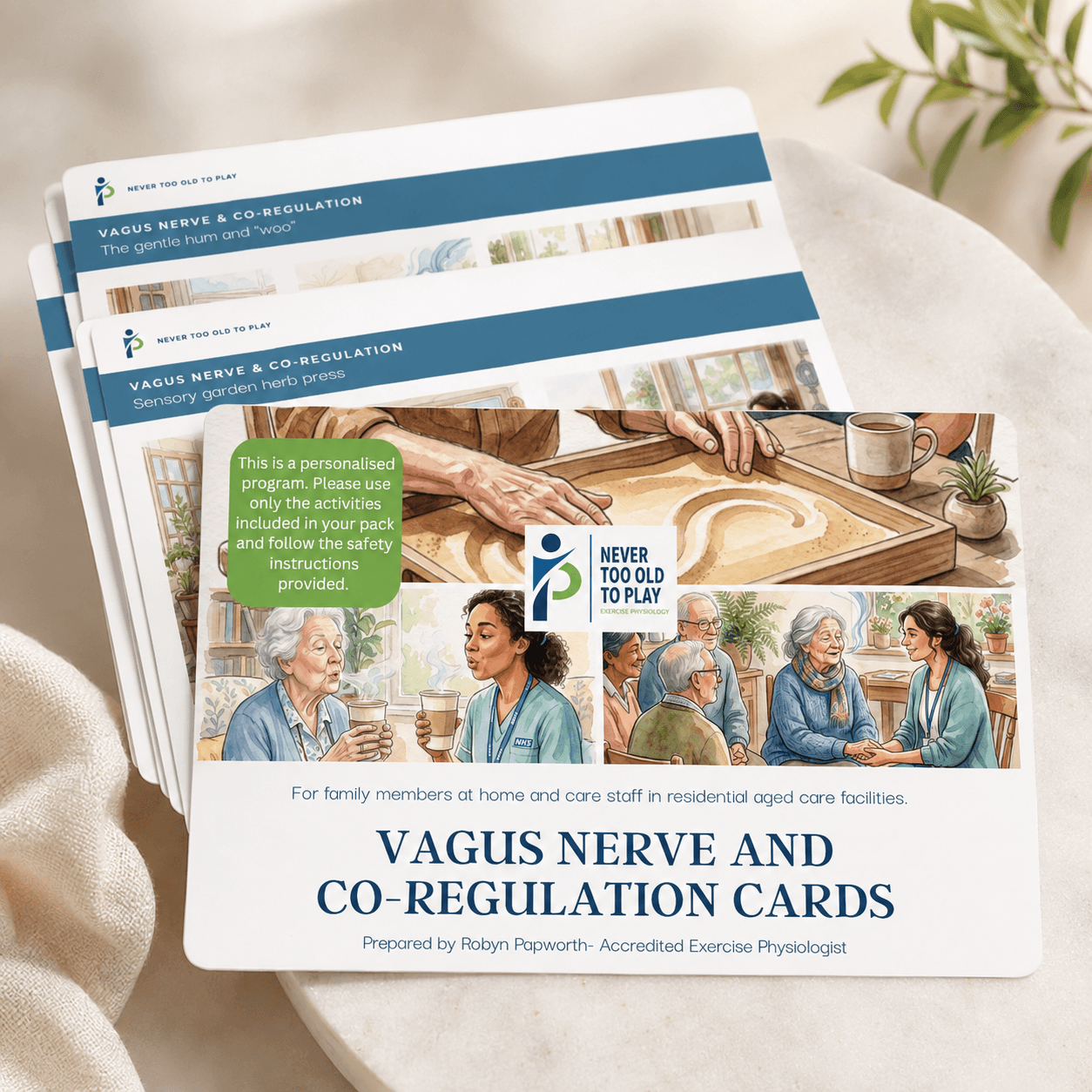
This is why I created the Co Regulation Sensory Cards
Sometimes a family member or support worker does not need another complicated program.
They need an idea.
Something that gives two people somewhere to start together.
Music, rhythm, movement, familiar objects, sensory experiences, conversation and ordinary activities can all create opportunities for connection.
That is the thinking behind my Co Regulation Sensory Cards.
The activity is not there to make every interaction feel like therapy.
It is there to create an opportunity.
Sometimes the activity is just the doorway into connection.
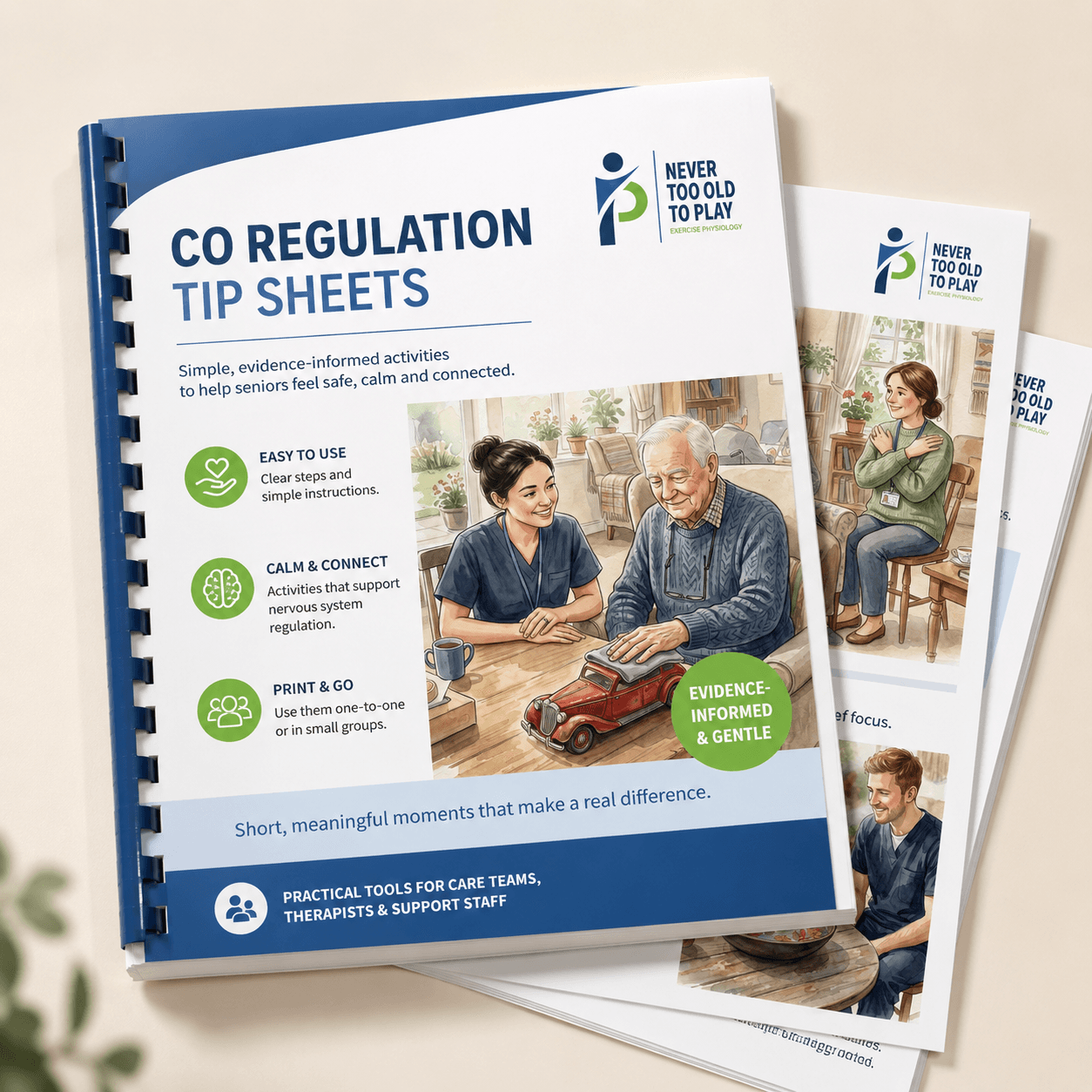
Care teams also need ideas that are easy to share
This is also why I created my Co Regulation Tip Sheets.
A useful idea should not always require somebody to complete another course before they can try it.
A tip sheet can be shared at handover, discussed during a care team meeting or kept somewhere workers can reach for it when they need another idea.
Playful movement is different from Exercise Physiology
There is an important distinction in my work.
Enjoyable movement, music, sensory activities and playful experiences can be valuable parts of everyday life.
But they are not a replacement for individual Exercise Physiology when somebody has specific needs around balance, pain, falls risk, strength, mobility or physical function.
That is why my Personal Exercise Physiology Pack is personalised rather than a generic deck of exercises.
One part of my work asks what this person might enjoy doing.
Another asks what movement support this particular person needs.
Often good support considers both.
I want us to protect play across the lifespan
I do not think play has an expiry date.
It may look different at 85 than it did at eight, but curiosity, enjoyment, movement, music, creativity and shared experiences can still matter.
We are all never too old to play.
Keep exploring
Co Regulation Sensory Cards
40 practical ideas for movement, sensory experiences, music, conversation and connection.
Learn more
Co Regulation Tip Sheets
Practical ideas designed to be easy for care teams to share and use.
Learn more
Personal Exercise Physiology
Individualised movement support selected around one person's needs and goals.
Learn more
This article provides general educational information. It is not an individual exercise prescription. Movement and activities should be appropriate to the person, their abilities, environment and support needs.